
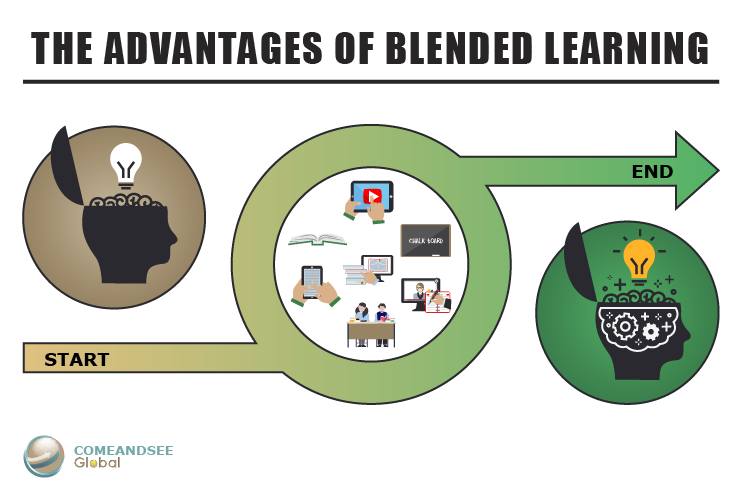
What is blended learning? It is an approach to training that mixes the use of eLearning, mobile learning, classroom-based and face-to-face instruction. Ideally, all of these learning styles should complement each other in making the training experience more efficient.
Blended learning is trajected to the future of training for organisations. Recent situations, such as the Covid pandemic, have shown us that we cannot be too reliant on the traditional classroom training, and that solutions need to be provided for remote training and working situations.
So, how can blended learning be an advantage to employees? Let’s have a look at some of the advantages:
- Accessibility and flexibility
The beauty of blended learning is that it offers flexibility in the way learners conducts their learning. For example, they could pause for reflection, for review, for a break, etc. Another scenario would be the flexibility of being able to access the training courses across different devices, which means the learners are not restricted in how, when or where they do the training. - Self-paced learning
Not every learner is the same; some are faster than others. Blended learning virtually eliminates the chances of learners not being able to keep up. They can learn at their own pace and ask any questions when they meet the trainers in person. This is especially useful for technical courses as the employees can always refer back to the materials until they fully understand it. - Varied modes of learning
While some flourish in a traditional training setting, others require a more non-traditional method to learn better. The variety of approaches that blended learning employs helps learners understand and digest difficult concepts better. More effective training will produce more skilled employees. - Easy to track progress and get feedback
Blended learning makes it easier to track the progress of employees and keep things systematic. Evaluating an employee could be done using an online assessment platform with a built-in grading system, and this allows for immediate feedback. Likewise, feedback can be collected easily online after completing online courses compared to collecting physical feedback. - Cost-effective
Cost-effectiveness is what attracts most organisations to do blended learning as part of their workplace training. Organisations do not need to rent a training space and instructors are not required to be present physically. Moreover, spending is reduced further since the training is done online and courses can be updated easily and quickly.