
There are many steps and stages involved in developing a serious game, and without proper organisation it can be difficult to begin. However, with the use of some simple checklist and frameworks, developing a serious game can be a smooth process.
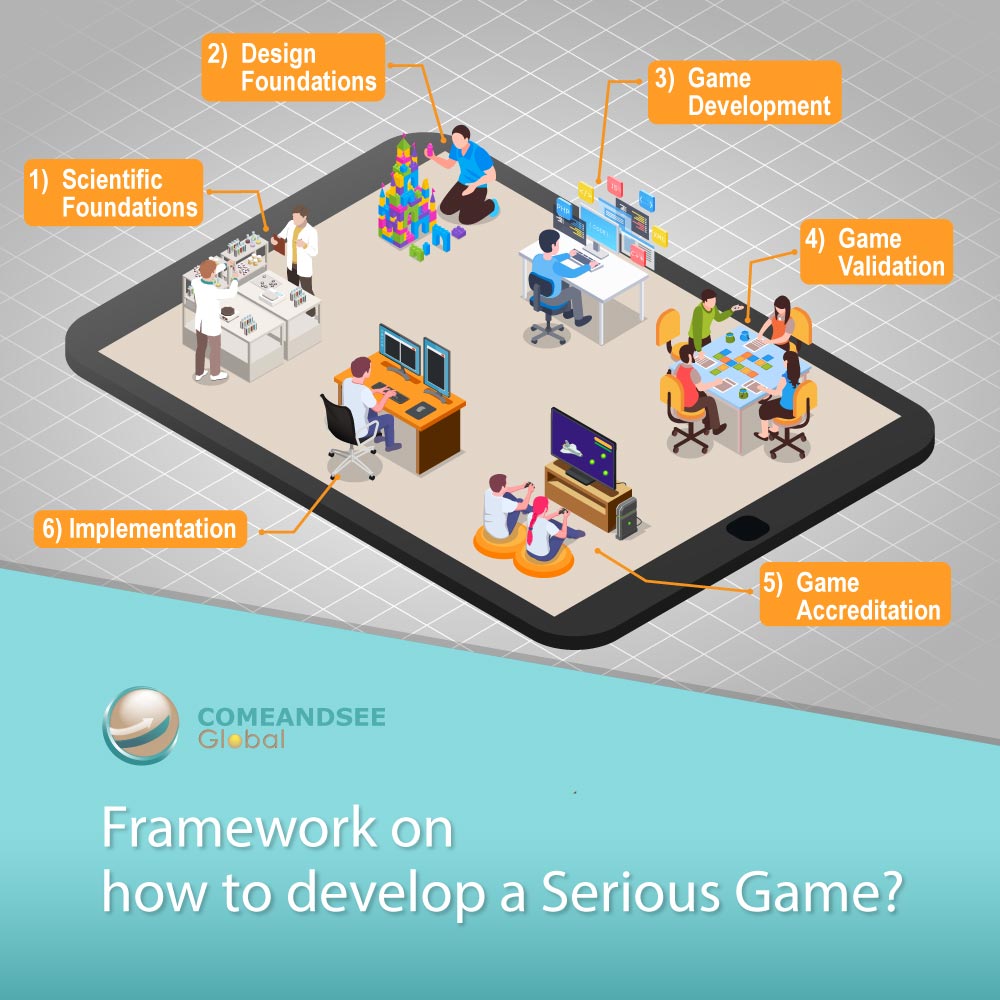
By looking at the ‘Mindbytes Evidence-based serious games validation model’, the development of serious games can be easily separated into 6 stages:
Stage 1: Scientific Foundations
Here is where we identify the target audience, objectives and gaming method to be used to achieve the outcome. It is important to establish these parameters firstly before beginning any design work to ensure that the final product will be relevant, theoretically driven and evidence based.
Stage 2: Design Foundations
Instructional designers and game developers will then need to translate the scientific foundations to design elements by adopting the appropriate game mechanics, design and technological features to achieve the outcome.
Stage 3: Game Development
In this stage developers should focus on developing a practical and outcome-focused development, by choosing the game genre and algorithm that will best achieve the outcome requirements, the narrative content that will move the story forward and the visuals and user interface to consider.
Stage 4: Game Validation
After development, it’s now time to move to the validation process. It is important that the purpose of the game be reflected properly in all aspects including the design and the system. It is here that we will see whether or not the game possesses the seven criteria of a good serious game:
- Purpose
- Content
- Fiction and Narrative
- Mechanics
- Aesthetics and Graphics
- Framing
- Emotion, Motivation and Memory
Stage 5: Game Accreditation
In the accreditation stage, the game is tested on whether it is to be deemed ready for the serious games market or not. This can be achieved by using the Dutch Society for Simulation Health (DSSH) Validation Framework that assesses 5 main themes of:
- Serious game description
- Rationale
- Functionality
- Validity
- Data safety
Stage 6: Implementation
After further refinement based on the findings of stage 4 and 5 and consultation with various stakeholders, the serious game should be ready for an effective implementation and roll-out to the market.
It is always best to continually monitor and follow up on the game to collect user feedback to improve the game and for future projects.