
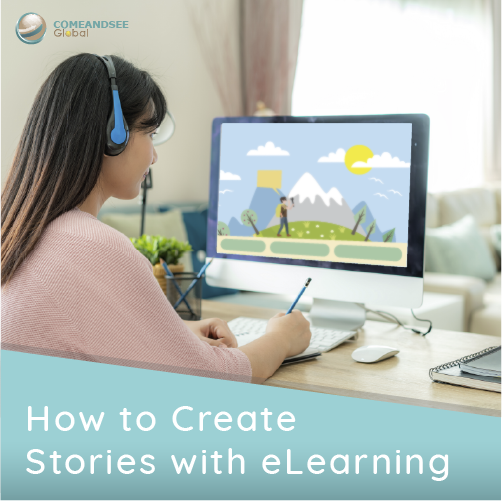
Stories have always been a powerful tool of communication. Our brain’s ability to remember facts and information is much higher when told within a story than if it was listed down in bullet points. In fact, in an exercise by Chip Heath, a professor at Stanford Univerty, when the students heard facts in story form, 65% could recall the information, as opposed to 5% who only heard statistics alone.
The impact of storytelling can be translated to eLearning as well. However, not just any stories can be thrown in – they would need to have the right attributes to be able to resonate with your learners and help make your eLearning more effective.
Here are some tips to consider when adding stories to your eLearning:
- Make it Relevant and Relatable
The learner should be able to see themselves experiencing the story and how they can transfer it to their own lives. This will help them see how they can learn from it, provides goals to achieve and behaviours to emulate. If they don’t connect with it, it is less likely to stick in their minds.
- Make it Coherent
While the story does not have to be complex, it should have a coherent flow. A typical story would have a beginning, a middle and an end. Your elearning should involve a storyline that introduces the character or scenario, builds up the narrative that takes them through problems or challenges, and ends with a conclusion that provides take-aways or a call to action. - Stimulate the Senses
Take full advantage of the different mediums available to present your story. Rather than just providing descriptions, include images, videos or animations that can help the learner visualise the complete picture in their minds. Additionally, include background music and sound effects to enhance the narrative and create an immersive experience the learner. - Ground it in Objectives
While creating the story, it is important to keep in mind the learning objectives so that you don’t lose sight of what you want to achieve through the story, or overwhelm the learners with irrelevant information. Otherwise, the story may be engaging, but would not offer any significant or relevant values. - Make it Interactive
You can also consider adding activities that can branch the story out into different outcomes, and can help the learner see the consequences of their actions within a controlled environment. The added level of interactivity can make a course more engaging and immersive, as the learner is more directly involved in how the story unfolds.