
Have you heard the saying “humans are social creatures”? But how does it apply in terms of learning?
According to Bandura’s Social Learning Theory, we retain information more when the content is contextualised and when we have an emotional connection to it. For example, would you recall the side effects of Ibuprofen more from a pharmacology lecture or from listening to a friend’s story? If you thought the latter, you’re probably not alone. This is because your friend’s story would include a context in which they experience the side effects, such as being too sleepy to drive to a gathering after taking the medication.
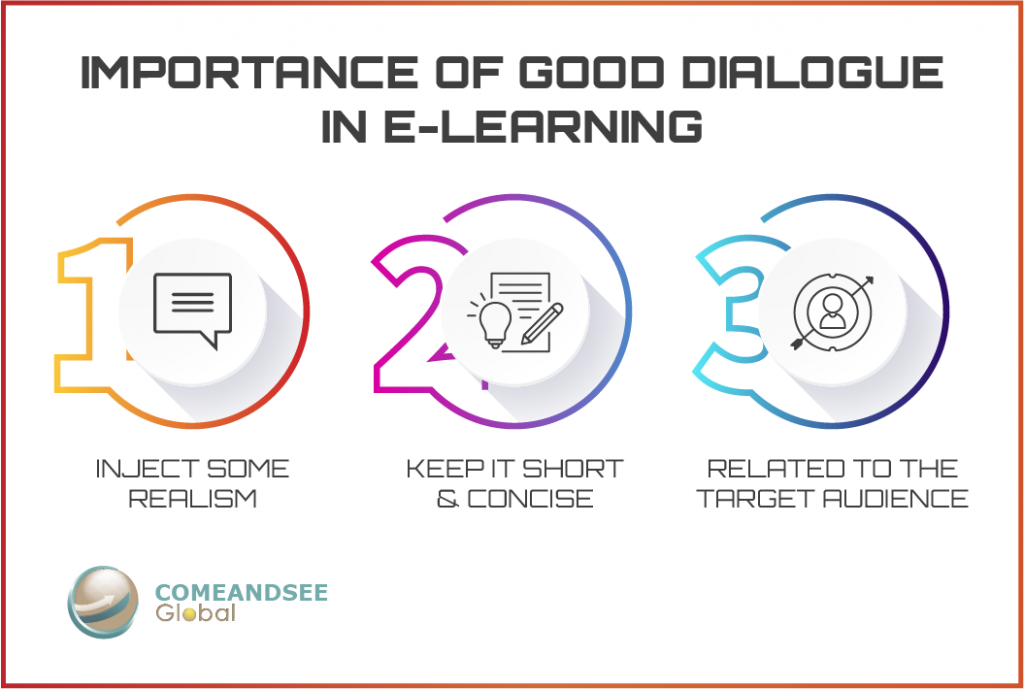
Many e-learning courses have incorporated this strategy by presenting content through simulated conversations, as it is an effective way of engaging your audience and it easily accommodates for story-based or scenario-based learning. However, there is also the possibility of composing dialogue that is too dry. In order to avoid this, here are some tips to follow:
- Inject some realism
Ensure that the conversations in the course sound like real conversations. This links to Mayer’s Personalisation Principle in Multimedia Learning, which proposes that people learn better when the content is delivered in an informal, conversational style. Avoid using a passive voice and use personal pronouns instead (e.g. ‘I’ and ‘You’). Also, try to use simple terms wherever possible and use contractions. When in doubt, try reading the script out loud – does it sound natural? Try to script it in the way you would talk about the topic in a similar situation in real life. - Keep it short and concise
Another important thing to keep in mind is to keep the sentences short and concise. Sometimes, we wanted the learner to understand what we’re saying so much that we cram as much information as we can into one sentence. This will only deter the learners from actually reading the text. Instead, use visuals to contextualise the conversation so that there is no need to explain the whole situation within the text itself. - Relate to the target audience
Personalized learning provides great flexibility in many ways. By moving away from traditional time-sensitive learning paths, learners can structure for themselves the methods and resources that they feel are necessary to reach their own learning goal at their own pace, allowing them to take additional time, if needed, to master a certain course.
Although the suggestions above are applicable to a wide range of learning needs, always go back to the target audience when deciding the overall tone. Ultimately, the dialogue should be modelled closely to how the target audience would talk on a daily work basis. For example, if they work in a corporate setting, the tone should not be too informal. By doing so, the learner can relate more to the characters, hence making their learning more meaningful.
In conclusion, when developing an e-learning course that is conversation-driven, it is important to compose dialogue that captivates the learner, as this can promote better retention of the content.