
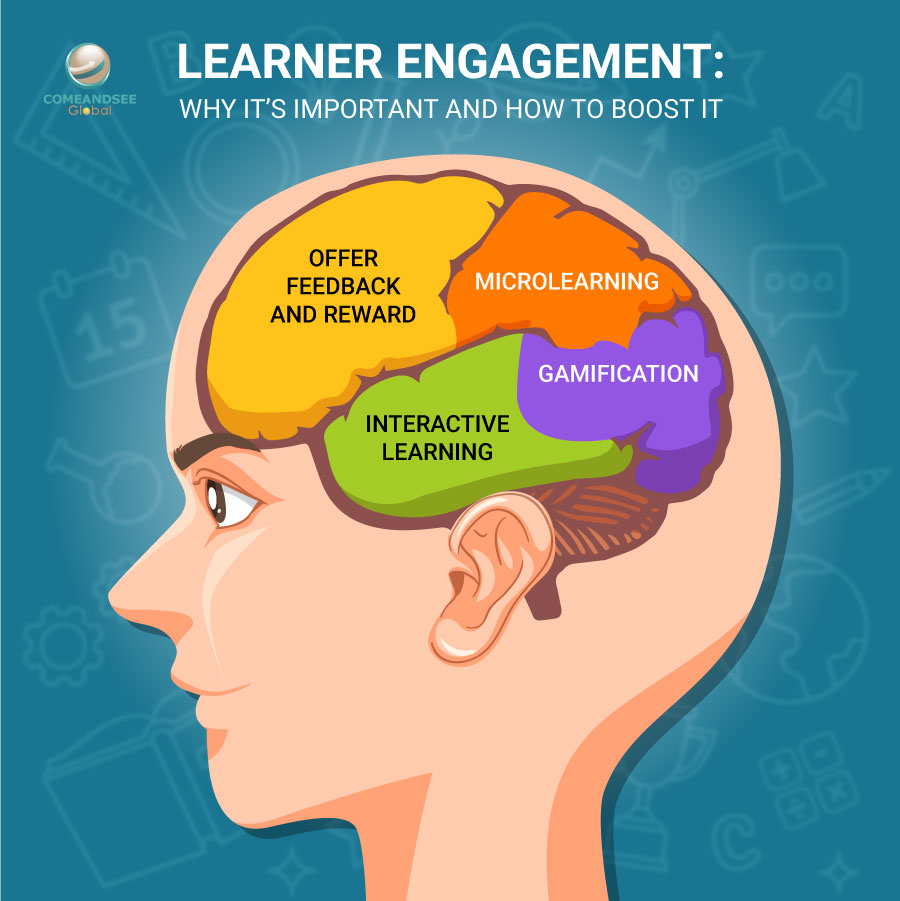
“Tell me and I forget. Teach me and I remember. Involve me and I learn” – Benjamin Franklin.
Learner engagement can be referred to as the willingness of a learner to interact consistently with the training provided in order to achieve a learning goal.
To put it simply, engaged learners are:
- Active,
- Eager to participate; and
- Willing to make effort.
With adult learners, there can be a number of barriers to engagement. They can lose interest or motivation easily as most would have family distraction as well as work and other commitments. Hence, online courses and training must do more than just simply provide information to the learners.
In this article, we will talk about the importance as well as some strategies that can help boost learners’ engagement.
1) Offer Feedback and Reward
A way to boost learners’ engagement is to reward, and acknowledge the time and efforts invested in learning. For example, offering a badge for each activity, or when a piece of content is completed. Another example is the use of certificates. This is more meaningful to adults, as not only they want to build their skills, but also to have something to show for it.
Besides the types of acknowledgements mentioned, offering real-life rewards may also help in increasing engagement, some examples may include performance bonuses or promotions where relevant.
2) Microlearning
By breaking content into smaller, bite-sized lessons, microlearning can help increase engagement in learners. It is a popular choice among course creators and takers as it provides concise and targeted objectives with the necessary amount of information, making it easier for the learners to digest and retain information.
This can be seen according to a report article by Software Advice on 7th June 2016, indicating more than 50% of the employees said that they would use more of their company’s learning tools if the course contents were broken up into shorter, and multiple lessons.
3) Gamification
Gamification is another approach where learners’ engagement can be increased. Gaming elements, such as challenges and rewards, are being implemented into a non-gaming context, for instance, employee training. This experience will make them feel more engaged and increase their desire to continue learning.
Other than that, research has shown that 90% of employees are more productive when gamification is used. It also increases on-the-job engagement levels. This can be seen in the same research where 30% of the respondents admits that gamification leads to an increased desire to be engaged while at work.

4) Interactive learning
Another way to boost learners’ engagement is by interactive learning. Learners tend to focus more if the content is delivered creatively. This can be done by using a combination of different formats such as using quizzes, interactive videos and drag and drop activities.
An example of interactive learning would be Scenario based learning. Typically, learners will be presented with a scenario based on real life situations with problems to solve, while still providing the learners with the required information. This creates an environment where they can’t help but be engaged as it stimulates their curiosity.
In conclusion, increased learner engagement is not only helpful to the individuals’ performance and productivity, it also leaves a positive impact such as increased productivity, efficiency, and customer satisfaction.
At Comeandsee Global, we provide engaging, broad-ranging finance and compliance courses that creates long lasting engagement. Learn more about our courses at smartlearn.comeandsee.com.sg
——————
Sources: